OpenAI’s GPT-5.6 launch and what it means for African developers building with RodiumAi
OpenAI has introduced a new family of models centered on GPT-5.6, with improvements that reportedly span multiple use cases, including cybersecurity. The original report from TechCrunch AI highlights a familiar trend in the AI market: frontier models are becoming more capable, more specialized, and more useful for production workloads.
For developers in Africa, the important question is not just what the model can do, but how quickly you can turn that capability into a reliable product. That is where RodiumAi matters. With a single OpenAI-compatible API, access to 60+ models, and mobile money payment via RODI credits, RodiumAi helps teams prototype, test, and ship AI features without the friction that often slows down adoption.
Why GPT-5.6 matters
The headline improvement in this release is broad model quality, with cybersecurity standing out as a particularly important area. In practical terms, that could mean better code analysis, stronger threat detection, improved phishing detection, more accurate security summaries, and more reliable agentic workflows for security operations.
For African startups and engineering teams, this is relevant in several ways:
Security tooling is becoming more accessible
AI-assisted coding and review can reduce engineering overhead
Customer support and fraud detection systems can become smarter
Local products can compete with global SaaS tools faster
The real opportunity is not to wait for a perfect model. It is to build workflows that use the best available model for the task, then iterate based on cost, latency, and quality.
What this means for developers in Africa
Many African teams face a common set of constraints: limited access to enterprise procurement, payment friction, variable latency, and the need to launch lean. RodiumAi is designed around those realities.
Instead of integrating separately with multiple model vendors, you can use RodiumAi as a single infrastructure layer. That means:
one API format,
multiple model choices,
RODI credits for payment,
and a dashboard to manage usage.
If GPT-5.6 or similar frontier models are available in your stack, you can use them for high-value tasks like:
security incident summarization,
malicious email classification,
vulnerability explanation for developers,
code review assistance,
internal policy Q&A,
and SOC analyst copilots.
If you want to compare available models, start here: RodiumAi models.
A practical cybersecurity use case
Imagine you are building a security assistant for a fintech company in Lagos, Nairobi, or Accra. Your product needs to:
read suspicious login events,
summarize likely attack patterns,
recommend next actions,
and explain the issue in plain language to non-technical staff.
A stronger model family like GPT-5.6 can help with reasoning and explanation quality. But the key is to wrap that capability in a clean product flow, with logging, prompt controls, and fallback logic.
On RodiumAi, you can route these tasks through whichever model best fits your cost and quality target. For example, use a frontier model for incident analysis, then a smaller model for routine classification. That keeps your system efficient.
Python example, calling RodiumAi
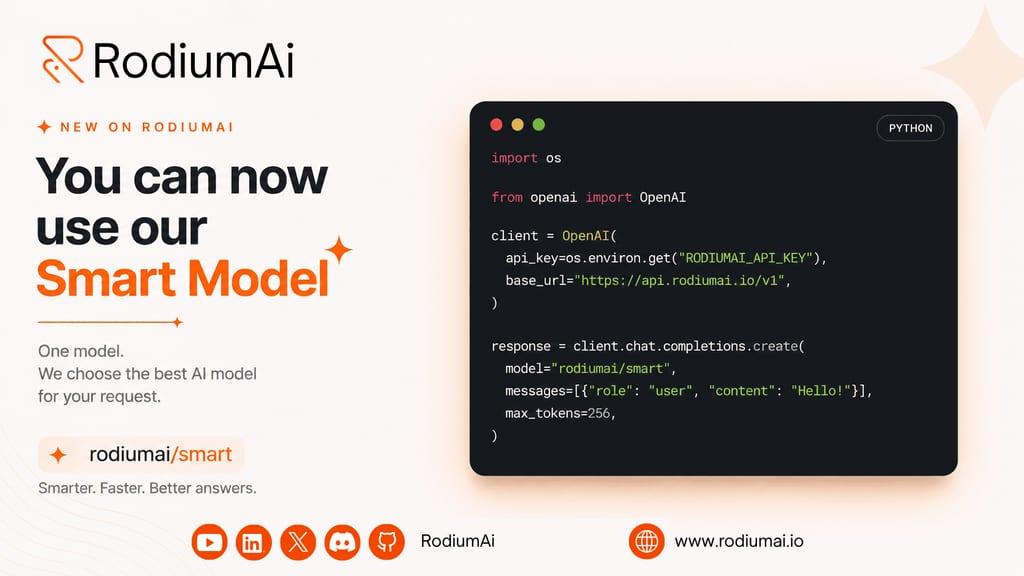
Below is a simple Python example using the RodiumAi OpenAI-compatible API.
from openai import OpenAI

client = OpenAI(
    api_key="YOUR_RODIUMAI_API_KEY",
    base_url="https://api.rodiumai.io/v1"
)

response = client.chat.completions.create(
    model="openai/gpt-5.6-sol",
    messages=[
        {"role": "system", "content": "You are a cybersecurity analyst."},
        {"role": "user", "content": "Summarize this alert: Multiple failed logins followed by a successful login from a new country."}
    ]
)

print(response.choices[0].message.content)
If you want to explore model options before choosing one, check the relevant model page format on RodiumAi, for example: https://www.rodiumai.io/models/{provider}/{model-slug}
JavaScript example, calling RodiumAi
Here is the same pattern in JavaScript.
import OpenAI from "openai";

const client = new OpenAI({
  apiKey: process.env.RODIUMAI_API_KEY,
  baseURL: "https://api.rodiumai.io/v1",
});

const response = await client.chat.completions.create({
  model: "openai/gpt-5.6-sol",
  messages: [
    { role: "system", content: "You are a cybersecurity analyst." },
    { role: "user", content: "Classify this email as safe or suspicious and explain why: 'Your account will be locked unless you verify immediately.'" }
  ],
});

console.log(response.choices[0].message.content);
How to choose the right model
A common mistake is to use the most powerful model for every request. That increases cost and can make your app slower than it needs to be.
A better approach is to design a model strategy:
Frontier model for complex reasoning, security analysis, and high-stakes outputs
Mid-tier model for product support, summarization, and structured extraction
Smaller model for classification, tagging, and simple routing
RodiumAi makes this easier because you can test multiple models from one platform. If you are building for users across Africa, this flexibility is valuable. You can optimize for:
cost in RODI credits,
response time,
and output quality.
Product ideas African teams can ship now
Here are a few products that could benefit from the kind of improvements highlighted in GPT-5.6:
1. Fraud and risk copilots
Banks, fintechs, and payment platforms can use AI to summarize suspicious activity and generate analyst-ready notes.
2. Secure code review assistants
Startups can build internal tools that flag risky patterns in pull requests and explain them in plain English.
3. Phishing detection for SMEs
Many small businesses do not have dedicated security teams. An AI assistant can help staff judge whether a message is suspicious.
4. Compliance and policy chatbots
Companies can expose internal security policies through a chat interface, reducing repetitive questions for IT teams.
5. Incident response summarizers
When an alert fires, the model can turn logs into a readable timeline and suggest next steps.
The bigger picture for Africa
Every major model release changes the baseline for what is possible. But African developers do not need to build directly on hype. They need dependable infrastructure, affordable access, and fast iteration loops.
That is the role RodiumAi can play. It gives teams a practical way to experiment with advanced models, pay locally through RODI credits, and deploy AI features without stitching together a fragmented stack.
If GPT-5.6 raises the bar for cybersecurity and reasoning, the opportunity for African builders is to turn that capability into products that solve real problems, from fraud prevention to secure software delivery.
Get started with RodiumAi
If you are ready to test frontier models in your app, start here:
API base URL:
https://api.rodiumai.io/v1
The next wave of AI products in Africa will not be built by waiting for access. They will be built by developers who can ship quickly, measure carefully, and choose the right model for the job.